
Curves have become increasingly common in modern residential interiors, but their purpose extends far beyond aesthetics. When thoughtfully integrated into architecture, cabinetry and furniture, curved forms can improve movement, reduce visual clutter and create a more comfortable living environment. This home demonstrates how strategic use of curves contributes to both functionality and visual harmony.
One of the fundamental principles of interior design is guiding how people experience and move through a space. While homeowners often focus on finishes, colours or furniture, the geometry of a home plays an equally important role in shaping everyday living. Straight lines provide structure and order, but introducing carefully placed curves can dramatically change how an interior feels without altering its overall layout.
Curves influence the way our eyes naturally travel through a room. Unlike sharp corners that create abrupt visual interruptions, rounded forms encourage continuous movement from one surface to another. This uninterrupted flow makes interiors feel calmer and more cohesive, particularly in compact homes where multiple functions share a limited footprint.
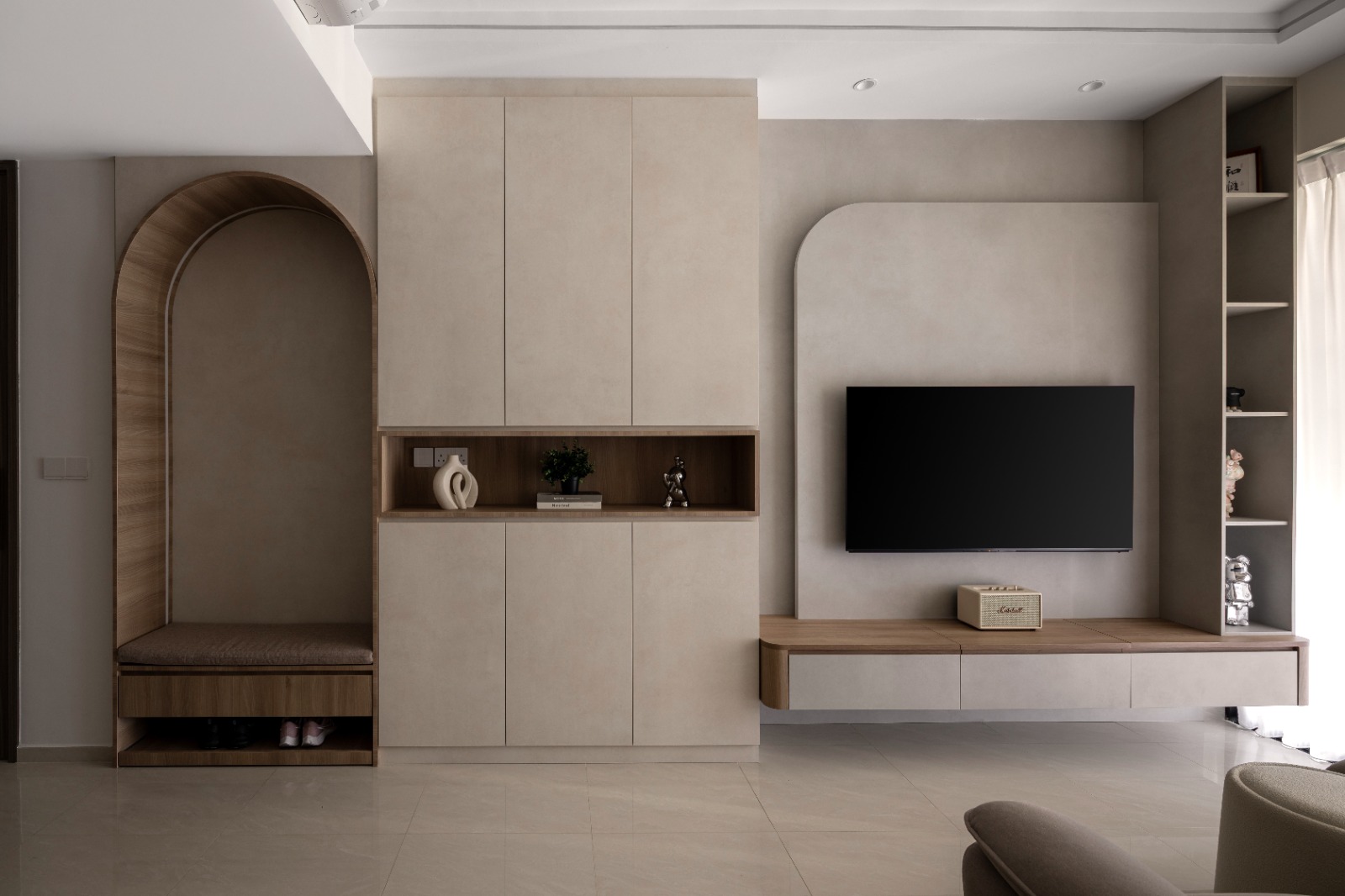
This principle can be seen immediately at the entrance of this residence. Rather than designing a conventional rectangular bench, the designer introduced an arched feature framed with warm timber and concealed lighting. The result is more than a decorative statement. The arch creates a welcoming focal point that softens the transition between the entrance and the main living area, making the home feel inviting from the moment one steps inside.
Curves also influence spatial perception. Research in environmental psychology suggests that people often perceive curved environments as more welcoming and less intimidating than spaces dominated by rigid geometry. While straight lines communicate precision and order, softer profiles introduce warmth without sacrificing simplicity. This balance is particularly valuable in contemporary homes that seek a minimalist appearance while remaining comfortable for daily living.
Beyond psychology, curved forms offer practical benefits in compact layouts. Many modern apartments have narrow circulation paths where cabinetry, dining tables and feature walls sit close to walkways. Sharp projecting corners can make these routes feel tighter than they actually are. By rounding edges at strategic locations, designers reduce visual obstruction while also making movement more comfortable. The improvement may seem subtle, but over years of daily use it contributes significantly to the overall living experience.
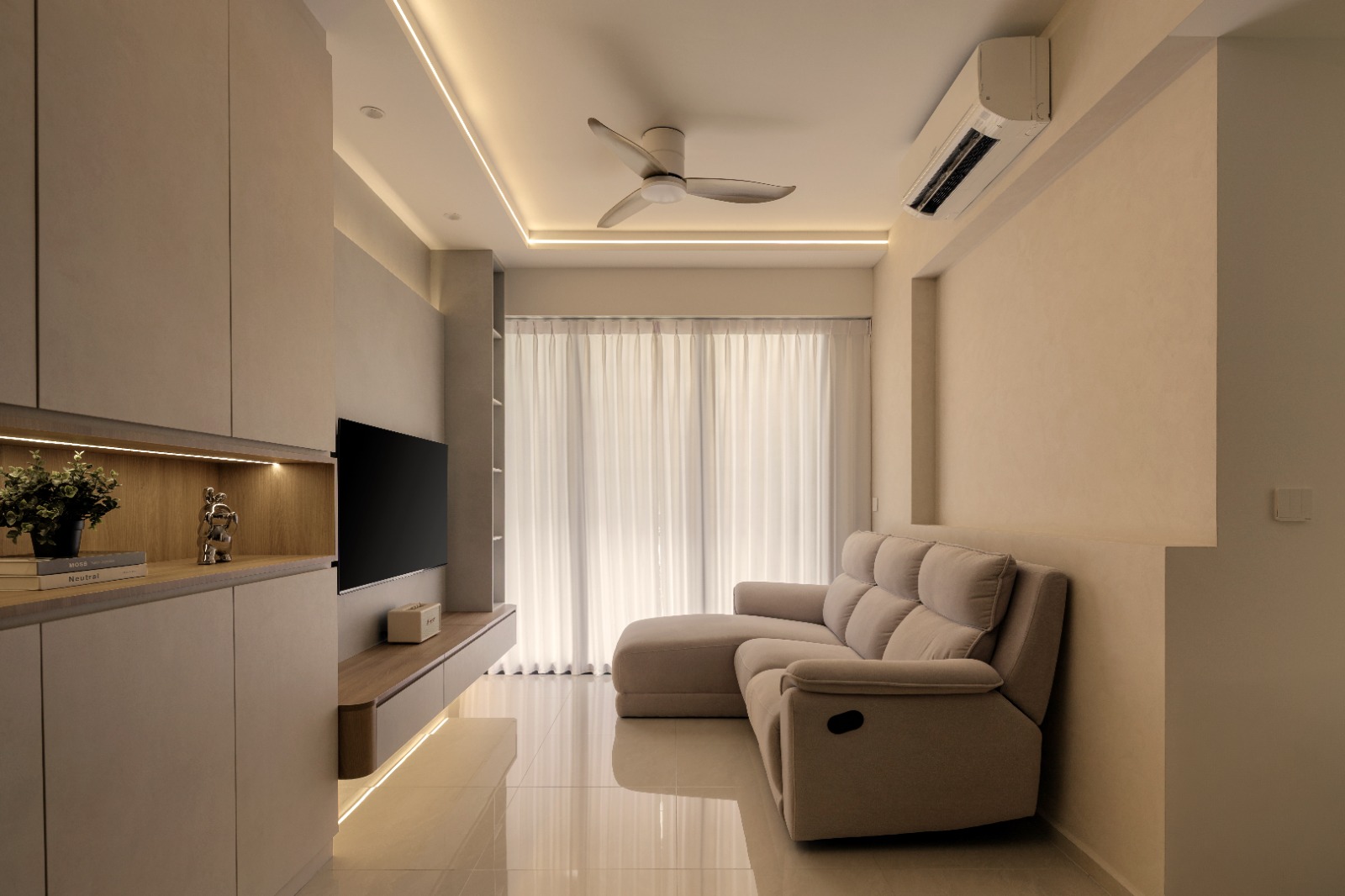
The television feature wall illustrates another important design principle. Rather than allowing the feature wall to terminate with sharp vertical edges, the curved transition softens what would otherwise be a large, dominant architectural element. This helps the television wall integrate naturally into the surrounding space instead of appearing visually heavy. As a result, the eye remains focused on the overall composition rather than a single feature.
Curves become even more effective when combined with thoughtful material selection. Throughout this home, textured neutral finishes are paired with warm timber accents to reinforce the softness introduced by the architecture. Instead of relying on bold colours or decorative patterns, subtle material variation creates visual depth while allowing the curved forms to remain the primary design feature. This approach demonstrates an important lesson in contemporary interior design: texture often creates more lasting interest than excessive colour contrast.
Furniture selection also supports the architectural language of the home. The rounded dining table mirrors the surrounding curved elements while providing practical advantages. Oval and rounded tables improve circulation because they eliminate sharp corners that extend into walkways. They also encourage conversation by reducing the physical distance between diners compared to rectangular tables of similar size. In smaller dining areas, this makes the space feel more intimate while allowing easier movement around the furniture.
Lighting further enhances the effectiveness of curved architecture. Concealed LED lighting integrated within the entrance arch and display niches accentuates the continuous lines without exposing the light source itself. This technique, known as indirect lighting, creates softer illumination by allowing light to reflect off surrounding surfaces. Besides reducing glare, indirect lighting adds depth and emphasises architectural forms that might otherwise appear flat during the evening.
An important consideration when incorporating curves is restraint. Curves are most successful when used intentionally rather than excessively. Applying them to every wall, cabinet and piece of furniture can make a home feel visually busy and may increase construction complexity. Professional designers typically introduce curves only at key focal points or transition areas where they provide the greatest functional and aesthetic benefit. In this home, the entrance, television wall and selected furniture pieces demonstrate how measured application creates a stronger overall composition.
The project also highlights how curved design can coexist with efficient storage planning. Full-height cabinetry remains predominantly linear to maximise internal storage and simplify organisation, while softer forms are reserved for exposed architectural elements that influence how the home is experienced visually. This balance ensures that practicality is never compromised in pursuit of aesthetics.
Perhaps the most valuable lesson from this residence is that successful interior design is rarely about individual features. A curved wall, an arched entrance or a rounded table alone will not transform a home. Instead, these elements work because they support broader principles of circulation, visual flow, proportion and functionality. Every design decision contributes to how occupants move, interact and feel within the space.
Ultimately, curves should not be viewed as a passing design trend. When applied with purpose, they become an architectural tool that enhances both the appearance and usability of a home. By improving circulation, softening visual transitions and creating a more welcoming atmosphere, curved forms demonstrate how thoughtful design can elevate everyday living without relying on unnecessary complexity.
Curved forms create softer visual transitions, improve circulation and make interiors feel more welcoming. They also reduce the harsh appearance often associated with spaces dominated by straight lines and sharp corners.
While curves do not increase the actual floor area, they improve visual flow by reducing abrupt edges and helping spaces feel more open and connected.
Curves work best at focal points such as entrance features, television walls, kitchen islands, dining tables or cabinetry edges where they improve both aesthetics and movement.
No. Besides their visual appeal, curved elements can improve circulation, reduce the likelihood of bumping into sharp corners and create a more comfortable spatial experience.
Not necessarily. Curves are most effective when used selectively. Combining curved focal points with clean linear cabinetry and architecture creates a balanced interior that remains timeless rather than overly decorative.